


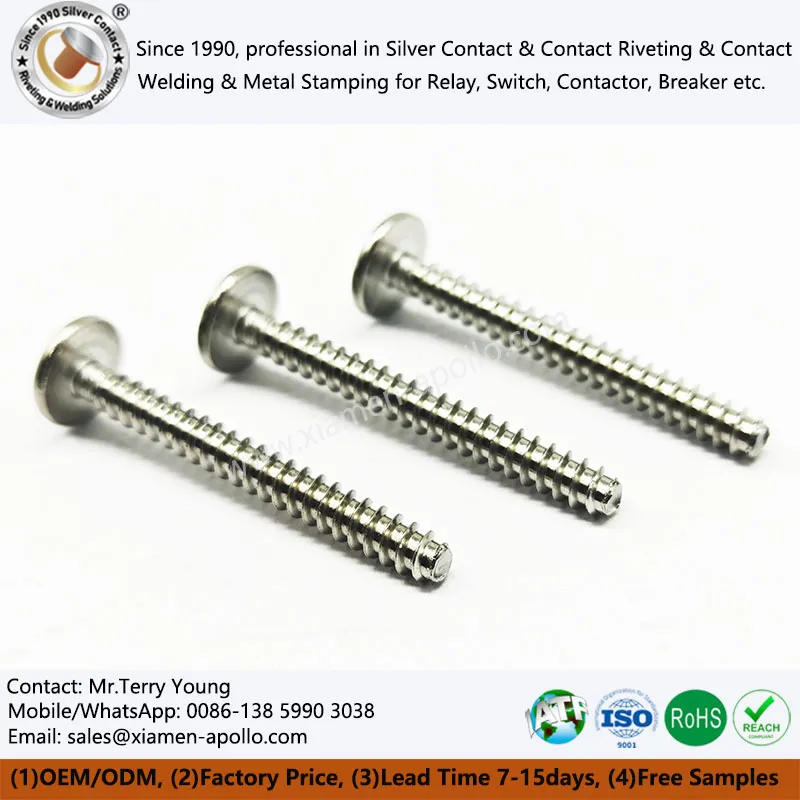


Self-tapping fastening screws, encompassing auto-tapping screws, self-drilling and self-tapping screws, self-drilling screws, and self-forming screws, are a versatile category of fasteners widely used across numerous industries. Auto-tapping screws, also known as self-tapping screws, feature sharp thread edges that can cut into materials to form mating threads, enabling secure fastening without the need for pre-drilled holes. Self-drilling and self-tapping screws combine self-drilling and self-tapping capabilities, featuring a drill-point tip that eliminates the need for pre-drilling. They can efficiently penetrate materials like metal sheets and plastics, making them suitable for fastening in various substrates. Self-drilling screws focus on the self-drilling function, equipped with a drill-point tip and a screw thread design that allows them to drill and fasten in one step. Self-forming screws, on the other hand, can deform or displace materials during insertion to create a fastening effect, often used in soft materials or when minimal material damage is desired.

High-Strength Steel Alloys
Many Self-Engaging Drilling Screw for Tapping are made from high-strength steel alloys. These alloys contain elements such as carbon, manganese, and silicon, which enhance the screw's tensile strength and hardness. The high tensile strength ensures that the screws can withstand significant pulling forces without breaking, making them suitable for heavy-duty applications. For example, in construction and automotive industries, where components need to be securely fastened under high loads, self-tapping screws made from high-strength steel alloys provide reliable and long-lasting connections. Additionally, the hardness of the steel allows the screw's thread and tip to maintain their shape during the tapping process, ensuring consistent performance.
Corrosion-Resistant Materials
To combat corrosion, especially in environments with high humidity, exposure to chemicals, or saltwater, self-tapping screws are often manufactured from corrosion-resistant materials. Stainless steel is a popular choice. Stainless steel self-tapping screws, particularly those of grades 304 and 316, offer excellent corrosion resistance due to the presence of chromium, which forms a passive oxide layer on the surface. This layer protects the underlying metal from oxidation and corrosion, making them ideal for outdoor applications like marine construction, outdoor furniture assembly, and the chemical processing industry. Another option is zinc-plated steel, where a layer of zinc is applied to the screw's surface. The zinc acts as a sacrificial anode, corroding instead of the base metal, thus providing a protective barrier against rust and corrosion.
In addition to the base materials, self-tapping screws can be coated with specialized substances to further enhance their performance. For instance, some screws are coated with a lubricant, such as PTFE (Teflon), which reduces friction during the driving process. This makes it easier to insert the screw into the material, especially in applications where a large number of screws need to be installed. Moreover, the lubricant coating can also help prevent galling, which is the sticking and seizing of metal surfaces during the threading process. Other coatings, like black oxide or phosphate coatings, are used to improve the screw's aesthetic appeal and provide additional corrosion resistance in certain environments.

Self-Acting Drilling and Tapping Screw are available in a wide range of thread specifications, such as M3, M4, M5, M6, M8, and M10. Different thread specifications cater to various fastening requirements. Smaller thread sizes like M3 and M4 are suitable for lightweight materials and small components, such as electronics and precision machinery. Larger thread sizes like M8 and M10 are ideal for heavy-duty connections in industrial machinery, construction, and automotive applications.
01
The head types of Self-Drilling Self-Cutting Screw include flat head, round head, pan head, hex head, and more. Flat head screws lie flush with the surface after installation, providing a sleek appearance and suitability for applications requiring a smooth surface, such as furniture and electronics enclosures. Round head screws feature a rounded top, offering good load-bearing capacity and ease of operation. Pan head screws have a distinct shape that provides excellent load distribution and resistance to loosening.
02
Self-Tapping Thread-Forming Nails come in various lengths to accommodate different material thicknesses and fastening depths. Shorter screws are suitable for thin materials or shallow fastening, while longer screws can penetrate thicker materials or secure multiple layers. Custom lengths can also be produced to meet specific customer requirements, ensuring precise fit and reliable connections in various applications.
03
The drive types of Self-Piercing Screws include slotted, Phillips, hexagonal, Torx, and more. Slotted and Phillips drives are common manual screwdriver types, easy to use, and suitable for most general applications. Hexagonal drive screws provide higher torque transmission and resistance to slippage, ideal for power tool applications. Torx drive screws offer better load distribution and durability, reducing wear on both the screw and tool.
04

Terminal Applications: Where Self-Tapping Screws Dominate
Self-tapping screws are ubiquitous across industries due to their speed and versatility:
Self-Drilling Screws: The fastener for metal roofing, siding, gutters, and structural cladding attachment to steel purlins/girts. Securing metal framing (studs, tracks). HVAC ductwork assembly. Perimeter security fencing. (HWH head + sealing washer is standard for roofing).
01
Auto-Tapping Screws: Assembling interior trim panels, wire harness clips, door panels, and headliners (often into plastic bosses). Joining thin sheet metal brackets. Electrical component boxes.
Thread-Forming Screws: Body panel attachment during repair/R&R. Securing trailer siding and flooring. Truck body assembly.
Self-Forming Screws: Critical for attaching components to plastic intake manifolds, valve covers, interior trim pieces, sensors, and electronic housings under the hood and interior.
02
Auto-Tapping Screws: Securing outer cabinets (sheet metal), internal brackets, wiring channels, motor mounts, and control panels in washers, dryers, refrigerators, ovens, etc. Often into sheet metal or plastic.
Self-Forming Screws: Used extensively for assembly involving plastic components like control knobs, chutes, dispensers, and internal liners.
03
Auto-Tapping Screws: Securing metal or plastic enclosures, mounting PCBs (into standoffs or chassis), and attaching components within panels. Type F or machine screw threads are common.
Self-Forming Screws: Securing components to plastic housings of computers, routers, power tools, and consumer electronics.
04
Self-Drilling Screws: Ductwork assembly, hanging pipes/equipment from metal structures, securing access panels.
Auto-Tapping Screws: Securing sheet metal covers, joining sheet metal components within units, and attaching controls.
05


Beliebte label: self-tapping fastening screw, China self-tapping fastening screw manufacturers, suppliers, factory


